




Turn a bottle of Ester-C around and the black-ruled box on the back answers most questions before the first tablet. Read it from top to bottom once, with the Daily Value for vitamin C in mind, and the odd numbers on it start to make sense. Our own panels make a good teaching copy, since every figure on them is one we print.
The title and the serving size set the terms
The words "Supplement Facts" at the top are more than a heading. FDA's Dietary Supplement Labeling Guide gives the nutrition label of a supplement that name. It asks for the title to be larger than any other print in the box and set in bold, with the panel enclosed by thin rules called hairlines. Packaged foods carry "Nutrition Facts" instead. One difference matters to a shopper: a Supplement Facts panel may name the source of an ingredient, which is how our labels can say what form the vitamin C takes.
Directly under the title sits the serving size, and every number below depends on it. FDA defines a supplement serving as the most the label recommends for one occasion, or one unit when the label recommends nothing at all. Its own example is plain. Directions of 1 to 3 tablets with breakfast make the serving 3 tablets.
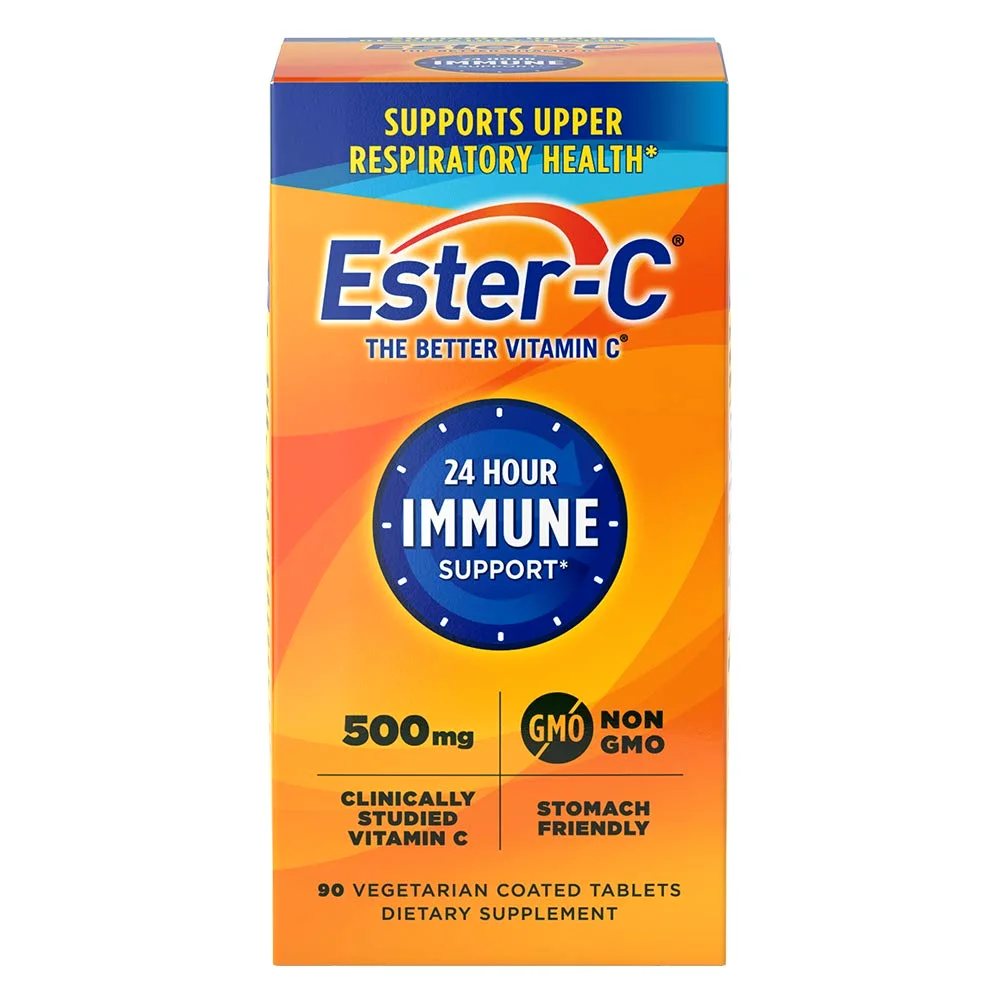
That rule answers a question we hear about our 500 mg products. Their directions call for two tablets daily, so the serving is two tablets or two capsules, and the panel shows 1,000 mg of vitamin C per serving. Each piece holds 500 mg. On our 1000 mg products a single tablet or capsule is the serving, and the panel reads the same 1,000 mg.
All six products therefore print the same vitamin C figure, and only the number of pieces changes. A bottle of 90 Ester-C 500 mg 24 Hour Tablets holds 45 servings, not 90. The guide also lets a maker skip the "Servings Per Container" line when it repeats the count on the front, so on a two-piece product you may need to divide by two yourself.
| Product | One piece | Serving | Bioflavonoid complex per serving | Servings per bottle |
|---|---|---|---|---|
| Ester-C Vitamin C 1000 mg Coated Tablets | 1,000 mg coated tablet | 1 tablet | 102 mg | 90 or 120 |
| Ester-C 500 mg 24 Hour Tablets | 500 mg coated tablet | 2 tablets | 204 mg | 45 in a 90-count bottle |
| Ester-C 500 mg with Citrus Bioflavonoids Capsules | 500 mg capsule | 2 capsules | 400 mg | 30, 60, 120 or 150 |
| Ester-C 1000 mg with Citrus Bioflavonoids Capsules | 1,000 mg capsule | 1 capsule | 200 mg | 90 or 105 |
| Ester-C 1000 mg with Citrus Bioflavonoids Vegetarian Tablets | 1,000 mg tablet | 1 tablet | 200 mg | 45, 120 or 180 |
| Ester-C 500 mg with Citrus Bioflavonoids Vegetarian Tablets | 500 mg tablet | 2 tablets | 400 mg | 45 or 225 |
| Amount Per Serving | Amount | %Daily Value |
|---|---|---|
| Vitamin C(as Ester-C® Calcium Ascorbate) | 1,000 mg | 1,111% |
| Calcium(as Ester-C® Calcium Ascorbate) | 110 mg | 8% |
| C-Sorb™ Citrus Bioflavonoid Complex | 102 mg | ** |
Citrus Bioflavonoid Complex (Citrus spp.) (peel and fruit), Sweet Orange, Tangerine, Lime, Lemon, Acerola Extract, Rutin, Hesperidin Complex (Citrus spp.) (peel), Naturally Occurring Vitamin C Metabolites
**Daily Value not established.
The panel of Ester-C 1000 mg Coated Tablets, set as text from the box.
Where 1,111% of the Daily Value comes from
Over the numbers runs a heading, usually "Amount Per Serving." FDA allows wording that matches the serving, such as "Amount Per 2 Tablets," and a maker may add a per-unit column beside the required per-serving one. Whatever the heading says, the figures under it describe the whole serving.
Vitamin C is listed in milligrams because its Daily Value is stated in milligrams. On FDA's current reference list that Daily Value is 90 mg. The percent is a short sum: divide the amount by the Daily Value, multiply by 100 and round to the nearest whole percent. One thousand divided by 90 gives 11.11, so our line reads 1,111%. FDA's guide, dated 2005, works the same sum with 60 mg as its example of 100 percent. Our panels divide by the 90 mg on the current list.
So what does a four-digit percent mean for your day? FDA describes Daily Values as amounts to consume or not to exceed, and its rule of thumb calls 20% DV or more per serving high. A percent above 100 says only that one serving holds more than the Daily Value. It is neither a target nor a limit.
The limit is a separate number found off the label. According to the NIH Office of Dietary Supplements, the adult upper limit for vitamin C is 2,000 mg a day, counting food, drinks and supplements together. Its recommended amounts are 90 mg for men and 75 mg for women. A serving of any of our products covers half of that upper limit. Juice at breakfast and a multivitamin count toward the same total, and our guide to how much vitamin C per day sets those figures side by side.
The milligram figure is also a commitment. FDA's guide says an added ingredient must be present at 100% of the amount declared, allowing for the testing method.
The source line explains why calcium appears
Beside the vitamin C figure, our panels add a phrase in parentheses: "as Ester-C® Calcium Ascorbate." That is the source line. Food labels cannot carry one, but FDA lets a supplement name the source of a dietary ingredient inside the Supplement Facts panel. It tells you the vitamin C comes as a calcium salt of ascorbic acid rather than as plain ascorbic acid.
Calcium is the other half of that salt, so it gets its own line. Our panels list 110 mg of calcium per serving, or 8% of the Daily Value, and the 1000 mg capsule panel prints 108 mg. Both round to 8% because FDA's Daily Value for calcium is 1,300 mg, and 110 divided by 1,300 comes to about 8.5 percent before rounding.
Notice what that calcium line weighs. FDA tells makers to list the weight of the calcium itself, not of the whole mineral salt, and spells the rule out with calcium carbonate as its example. Our 110 mg is calcium alone. The calcium ascorbate in the tablet weighs more, because it also carries the vitamin C.
If you track calcium from food and other supplements, add those 110 mg to the count. A doctor who has asked you to watch calcium will want to see this line.
Read the source line as a name, not a ranking. The NIH consumer fact sheet lists calcium ascorbate among the forms sold and says research has not shown any form of vitamin C to be better than the others. Our boxes print "Stomach friendly" and our bottles "Gentle and Non-Acidic," which speak to how the tablet sits rather than how much vitamin C it gives. We cover what stands behind those words on our page about buffered vitamin C and calcium ascorbate.
Two asterisks lead to "Daily Value not established"
Under the vitamin C and calcium lines, each of our panels lists a citrus bioflavonoid complex with a double asterisk where a percent would go. Follow the asterisks to the foot of the box and you reach three words: "Daily Value not established." FDA asks for exactly that treatment for any dietary ingredient without a Daily Value. The maker lists it by its common name, gives its weight per serving and points the percent column to that footnote.
Nothing in the footnote is a warning. No federal reference amount exists for bioflavonoids, so there is nothing to divide by, and any percent printed there would be made up.
Our complex reads citrus bioflavonoids (fruit), sweet orange, tangerine, lime, lemon, acerola, rutin, hesperidin complex and naturally occurring vitamin C metabolites. The word "fruit" is another rule at work. FDA requires a supplement panel to name the part of the plant an ingredient comes from.
Look at how the weight is given. The complex carries one weight for the whole mix, not a weight for each fruit. FDA's guide describes this format for blends: a single total weight on the line, with the ingredients named beneath it. From the panel you learn what goes into the complex and how much complex a serving holds, but not how much of it is lemon.
That total changes from product to product, and it is the line worth comparing across our bottles. A serving of the 1000 mg coated tablets carries 102 mg. The 500 mg 24 Hour tablets carry 204 mg, the 1000 mg capsules and vegetarian tablets 200 mg, and both 500 mg citrus bioflavonoid products 400 mg. For sizes and prices as well, the Ester-C comparison page lines all six up side by side.
Other ingredients sit outside the box
Under the panel, outside its rules, comes a separate list headed "Other ingredients." FDA's guide says binders, excipients and fillers belong in this ingredient statement and not inside the Supplement Facts box. These are the materials that turn a measured amount of calcium ascorbate and bioflavonoids into a tablet or capsule you can swallow.
On our boxes the list opens with vegetable cellulose. After it, under the words "less than 2% of," come calcium silicate, natural palm leaf glaze, vegetable magnesium stearate and vegetable stearic acid.
Shoppers who avoid a particular substance should read this list before anything else on the box. The word "vegetable" in front of the stearate and stearic acid names a plant source, which matters to some vegetarians. A glaze is a coating.
What the list leaves out is the weight of each item. Apart from vegetable cellulose, every material on it falls under the "less than 2%" ceiling. That ceiling already tells you how small those materials are next to a serving built around 1,000 mg of vitamin C.
Allergies call for a slower read. Go through the full statement each time you open a new size or a different product in our range, since the six do not share one formula. Ask your doctor or pharmacist about any name you do not recognize. Treat the marks on the front as a summary. The statement under the panel is the record.
Free-from marks tell you what was left out
Our bottles print a row of free-from marks: gluten-free, non-GMO, soy-free, yeast-free and dairy-free. The boxes go further, with no milk, no lactose, no wheat, no starch, no sugar, no fish, no artificial color, flavor or sweetener, sodium free and vegetarian friendly.
Each mark states what the maker did not put in. That helps when wheat or milk is off your list and you want to rule a product in or out before reading every ingredient. FDA's claims chapter counts a statement like "100 percent milk free" as a claim that helps people avoid milk products, not as a statement about nutrition. "Sodium free," by contrast, is one of the nutrient content terms FDA defines by regulation.
These marks also have edges. None of them tells you how much vitamin C a serving holds, how well a tablet suits your stomach, or whether the product fits your health. Non-GMO describes where ingredients came from, not how strong the tablet is. Vegetarian friendly describes the materials, and a diet stricter than that should go back to the other-ingredients list.
Think of the marks as a quick filter for the shelf. The panel answers how much, the ingredient statement answers what else, and only your own doctor or pharmacist can answer whether this is right for you.

The single asterisk and the FDA statement
On the front or side of a supplement box you may see a phrase about the body followed by a single asterisk. That symbol leads somewhere different from the double one inside the panel. It points to a boxed statement FDA requires whenever a supplement makes a structure/function claim.
A structure/function claim describes the role of a nutrient in the normal structure or function of the body. FDA's own examples include "calcium builds strong bones" and "antioxidants maintain cell integrity." Claims for vitamin C follow the same pattern: vitamin C is an antioxidant, and it supports normal immune function. FDA does not approve such claims ahead of time. Instead, the maker must hold evidence that the claim is truthful and not misleading, notify FDA within 30 days of first marketing it, and print the disclaimer.
Those words are fixed by regulation. For several claims, FDA's labeling guide gives the text as "These statements have not been evaluated by the Food and Drug Administration. This product is not intended to diagnose, treat, cure, or prevent any disease." A single claim opens with "This statement has not been evaluated" instead. Makers may not modify the wording. The disclaimer sits right next to the claim, or in a box linked to it by a symbol such as an asterisk, in bold type at least 1/16 inch tall.
Read that asterisk as a line between two kinds of promise. FDA's compliance guide says a general claim that a product "supports the immune system" is not specific enough to imply disease prevention, while "supports the body's ability to resist infection" is a disease claim. Under the law, only a drug may claim to diagnose, treat, cure or prevent a disease. A supplement label that names an illness it will stop has stepped over that line.
Directions, and what a label cannot tell you
Directions close the label. Our 1000 mg tablet boxes read: "For adults, take one (1) tablet daily, preferably with a meal." On our 500 mg tablet boxes the direction is to "take two (2) tablets daily." Those same directions set the serving size, so the panel and the directions always agree.
Keep in mind that the panel describes a full serving. One 500 mg tablet on its own carries half of each figure, 500 mg of vitamin C and about 55 mg of calcium.
Some questions sit beyond any panel. A label has no way to know your medicines, your history or your bloodwork. The NIH Office of Dietary Supplements notes that vitamin C supplements may interact with radiation therapy and with medicines including chemotherapy drugs and statins. It also describes one study where vitamin C with other antioxidants reduced the heart-protective effect of a statin taken with niacin. For people with hemochromatosis, a condition that makes the body store too much iron, the same source says high doses of vitamin C could worsen iron overload. Kidney stones also come up in its discussion of high intakes, though it adds that these concerns are not generally considered a risk in healthy people.
Pregnancy, breastfeeding, a history of kidney stones or a prescription list of any length are all reasons to bring the bottle to your doctor or pharmacist before you start. The ODS consumer sheet asks readers to tell their health care providers about every supplement and medicine they take, and its interactions section is a fair place to start your own questions.
| Line on the panel | What it tells you |
|---|---|
| Supplement Facts | The required name of a supplement's nutrition label, set larger than anything else in the box |
| Serving Size: 1 or 2 tablets or capsules | The most the directions call for at once. Every figure below refers to it |
| Amount Per Serving | The heading over the figures. It may read "Amount Per 2 Tablets" |
| Vitamin C 1,000 mg, 1,111% | 1,000 mg divided by the 90 mg Daily Value, times 100, rounded |
| (as Ester-C® Calcium Ascorbate) | The source line. It names the form of vitamin C |
| Calcium 110 mg, 8% | Calcium alone, from the same salt, against a 1,300 mg Daily Value |
| Citrus bioflavonoid complex ** | A blend with no Daily Value, given as one total weight |
| ** Daily Value not established | The footnote for any ingredient without a Daily Value |
| Other ingredients | Binders, fillers and coatings, listed outside the box |
| Free-from marks | What the maker did not add |
| * and the FDA statement | The claim is structure/function and was not evaluated by FDA |
| Directions | How many to take and when. They also set the serving size |