



If plain vitamin C tablets leave your stomach sour, the word "buffered" on a bottle starts to matter. It names a real change in the molecule, though not a change in the vitamin itself, and the research behind each form comes with limits worth knowing before you pay for one.
Vitamin C reaches the shelf in several forms
Every bottle in the supplement aisle promises vitamin C, but the Supplement Facts panels on the back name different compounds. The Office of Dietary Supplements at the National Institutes of Health (NIH) lists them plainly in its fact sheet for health professionals. Ascorbic acid is the most common form, and NIH says the ascorbic acid in supplements has the same bioavailability as the ascorbic acid that occurs naturally in foods such as orange juice and broccoli. Alongside it sit sodium ascorbate, calcium ascorbate, other mineral ascorbates, and ascorbic acid with bioflavonoids.
NIH then names combination products, and its example is Ester-C. The fact sheet describes it as calcium ascorbate plus dehydroascorbate, calcium threonate, xylonate, and lyxonate. Those four extra names are metabolites, compounds that vitamin C turns into as it breaks down. On our panels they appear as "naturally occurring vitamin C metabolites," listed inside the citrus complex, while the calcium ascorbate supplies the 1,000 mg of vitamin C in every serving.
So which form works best? The consumer version of the same NIH fact sheet answers in a single sentence: "Research has not shown that any form of vitamin C is better than the other forms." We would rather you read that line here than find it later on your own. Preference is a separate question from superiority, and for most people the preference starts with how a tablet sits in the stomach.
| Form | What NIH says about it |
|---|---|
| Ascorbic acid | The most common form in supplements, with bioavailability equal to the ascorbic acid in foods such as orange juice and broccoli |
| Sodium ascorbate | Listed among the other forms sold |
| Calcium ascorbate | Listed among the other forms sold |
| Other mineral ascorbates | Listed among the other forms sold |
| Ascorbic acid with bioflavonoids | One study found no differences in plasma vitamin C or urinary excretion compared with ascorbic acid and Ester-C |
| Ester-C (a combination product) | Calcium ascorbate, dehydroascorbate, calcium threonate, xylonate, and lyxonate. One study found the same plasma levels as ascorbic acid and higher leukocyte levels 24 hours after a dose |
What "buffered" means on a label
Ascorbic acid is, as its name says, an acid. A buffered vitamin C trades the hydrogen that makes it acidic for a mineral and becomes a salt: paired with sodium it is sodium ascorbate, paired with calcium it is calcium ascorbate. The ascorbate half of the molecule is the same vitamin in each case. What changes is how acidic the tablet is and which mineral comes along with the vitamin.
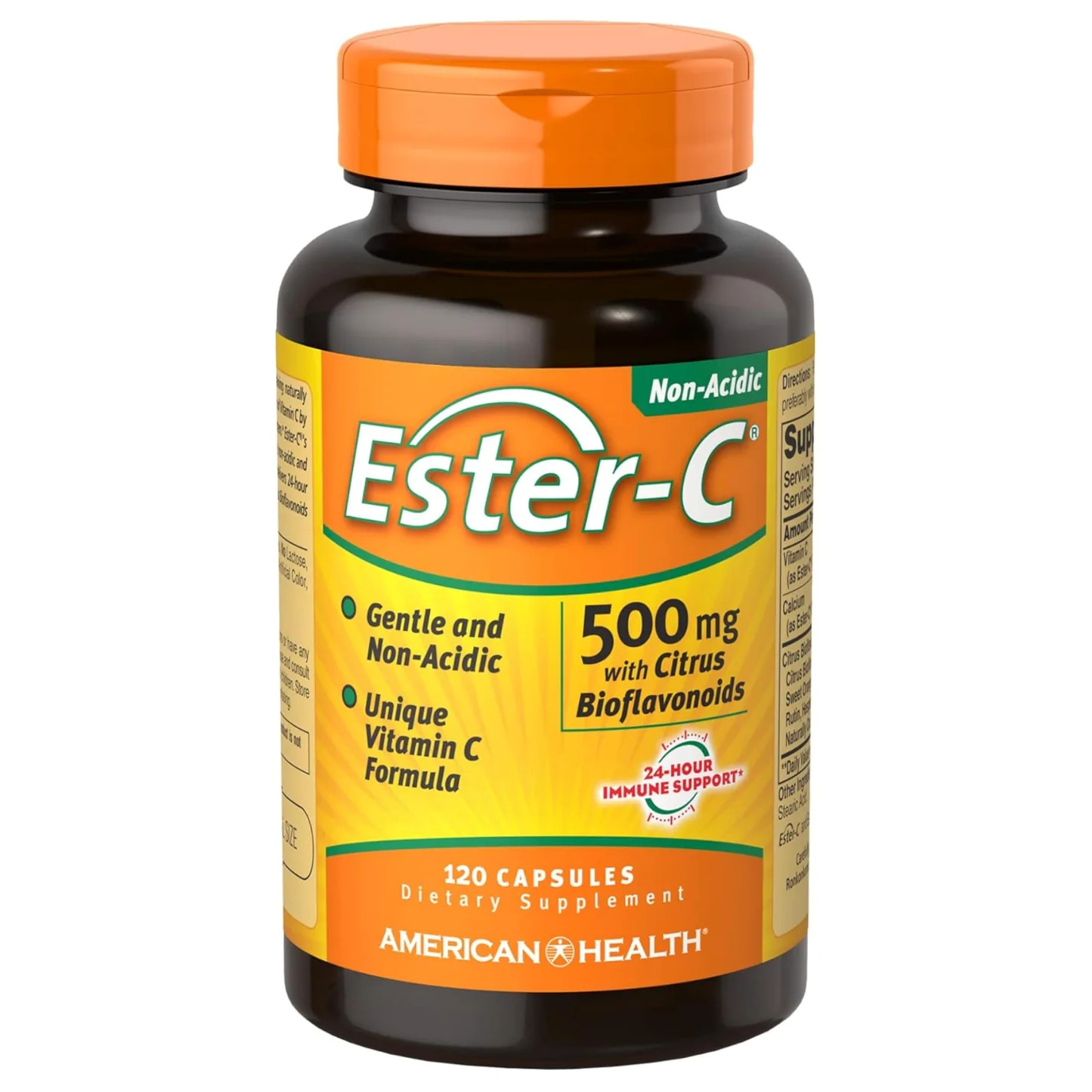
Our bottles print "Gentle and Non-Acidic," and our boxes print "Stomach friendly." Those phrases describe the calcium ascorbate base. The authors of a 2016 paper on Ester-C, three of them employees of the brand's owner at the time, described its pH as neutralized. They also wrote that people sensitive to acidic foods tolerate it better, citing an earlier tolerance trial.
The mineral is not decoration. A serving of any of our six formulas gives 1,000 mg of vitamin C as Ester-C calcium ascorbate, listed on the panel at 1,111% of the Daily Value. That same compound carries 110 mg of calcium. On the 1,000 mg capsule panel the figure is 108 mg. Sodium ascorbate would bring sodium instead, a detail that matters if you count salt, and our boxes print "sodium free."
Consider what buffering cannot do. It does not change how much vitamin C your body needs, and it does not raise the safe ceiling. NIH sets the Tolerable Upper Intake Level for adults at 2,000 mg a day from all sources and notes that high doses can cause diarrhea, nausea, abdominal cramps, and other stomach upset. A buffered form changes the acidity of a dose, not its size.

Why some people choose a non-acidic form
The case for buffered vitamin C rests on comfort, and the best-known test of it is a trial published in Advances in Therapy in 2006 by Joerg Gruenwald and colleagues. It enrolled 50 healthy volunteers sensitive to acidic foods. Each person took 1,000 mg of vitamin C as Ester-C for three days and 1,000 mg as plain ascorbic acid for three days, with a three-day break between. The order was random, and the trial was double-blind. Participants kept a daily diary of epigastric complaints, the burning or discomfort felt in the upper belly.
Across the nine days, 28 of the 50 people reported 88 such complaints, all mild to moderate. Of those, 33 followed Ester-C and 55 followed ascorbic acid. Asked to rate tolerability, 72% of participants called Ester-C "very good," against 54% for ascorbic acid, a difference the authors reported as statistically significant. Their conclusion was that Ester-C caused fewer epigastric complaints in people sensitive to acidic foods.
Read the size and the setup before you lean on that result. Fifty people over nine days is a small, short study, and it looked at stomach comfort, not at any health outcome. The abstract does not say who paid for the trial. PubMed tags it as research supported by a non-government source, and the first author's listed affiliation is Analyze and Realize AG in Berlin.
So the honest summary is narrow. If acidic foods bother you, one small trial found that people like you reported fewer stomach complaints on Ester-C than on ascorbic acid. For everyone else, the NIH line stands, and the form you choose matters less than keeping the dose within sensible limits.
What the maker's leukocyte study measured
Researchers comparing vitamin C forms can measure it in two places in blood: the plasma, which is the liquid part, and the leukocytes, or white blood cells. In a 2016 trial published in SpringerPlus, Susan Mitmesser and colleagues described plasma vitamin C as a reflection of recent intake and leukocyte vitamin C as a reflection of tissue stores. They gave 36 adults aged 18 to 60 three single doses on separate occasions: placebo, 1,000 mg of ascorbic acid, and 1,000 mg of vitamin C as Ester-C. The design was double-blind and crossover. Blood was drawn before each dose and again at 2, 4, 8, and 24 hours.
In plasma, the study found no significant differences in concentration between Ester-C and ascorbic acid, though the peak plasma level was higher for Ester-C. Leukocytes told a different story. The change from baseline rose with Ester-C at 24 hours, while ascorbic acid and placebo showed no significant change within their groups at any time point. Compared with ascorbic acid, the percent change in leukocyte vitamin C was higher for Ester-C at 8 and at 24 hours. The authors concluded that Ester-C is retained longer within leukocytes.
Now the part that matters as much as the numbers. The full paper states that the company that owned Ester-C at the time provided the funding and all study materials, and three of its four authors were employees of that company. That was one dose, in 36 people, measuring vitamin C levels in blood cells. It did not test whether anyone stayed healthier, and a higher reading in leukocytes is not, on its own, a benefit you would notice. We describe it as what the maker's study found, and nothing more.
The study that favors plain ascorbic acid
NIH's summary of vitamin C forms leans on two older trials as well. The first, by Mark Moyad and colleagues in 2008, enrolled 15 healthy men aged 18 to 39. Each man took, on separate days, plain vitamin C, two calcium ascorbate formulas with vitamin C metabolites, and a placebo, all as 1,000 mg preparations. Plasma vitamin C did not differ significantly between the preparations. At 24 hours, the calcium ascorbate with metabolites produced significantly higher vitamin C in leukocytes than vitamin C alone. The authors called their findings preliminary and wrote that a larger study was needed to confirm them and to judge their clinical relevance.
A second trial points the other way. NIH describes a 1994 study that compared ascorbic acid, Ester-C, and ascorbic acid with bioflavonoids. As NIH reports it, the researchers found no differences in plasma vitamin C or urinary excretion among the three. Given those results and the lower cost of ascorbic acid, the authors concluded that simple ascorbic acid is the preferred source of supplemental vitamin C. PubMed carries no abstract for that paper, so the NIH summary is our source for it.
Put the trials side by side and a pattern appears. Plasma concentrations showed no significant difference between forms in all three, apart from a higher peak for Ester-C in the 2016 trial. The leukocyte difference shows up in two small studies, one of them paid for by the maker, and none of these trials measured a health outcome.
If you pick Ester-C, the reasons that hold up are the ones you can judge yourself: how it feels to take, the calcium it carries, and a price you can compare. Our 1000 mg coated tablets in the 120-count bottle come to about 13 cents a serving.
Citrus bioflavonoids in our formulas
Each of our six formulas carries a citrus bioflavonoid complex alongside the vitamin C. The panels list it as citrus bioflavonoids from fruit, sweet orange, tangerine, lime, lemon, acerola, rutin, hesperidin complex, and the naturally occurring vitamin C metabolites mentioned earlier. Two formulas, the 1000 mg coated tablets and the 500 mg 24 hour tablets, use a version the panels call C-Sorb. Per serving, the amount runs from 102 mg in the 1000 mg coated tablets to 400 mg in the 500 mg capsules and the 500 mg vegetarian tablets, where a serving is two units.
What do the bioflavonoids do for you? No government source we have read supports a benefit from them. NIH mentions them only as part of a form, "ascorbic acid with bioflavonoids." The one study it cites on that form found no difference in plasma vitamin C or urinary excretion compared with plain ascorbic acid and Ester-C.
So we keep the claim small. The bioflavonoids are part of the formula, and the panel tells you how many milligrams each serving holds. Anyone who wants bioflavonoids named on the front of the bottle will find the four formulas that carry them in their names in the Ester-C with citrus bioflavonoids collection. The citrus content is also worth a glance if you avoid citrus for any reason, since sweet orange, tangerine, lime, and lemon all sit on the panel.
| Product | Serving | Vitamin C | Calcium | Bioflavonoids per serving |
|---|---|---|---|---|
| Ester-C Vitamin C 1000 mg Coated Tablets | 1 tablet | 1,000 mg | 110 mg (8% DV) | C-Sorb complex, 102 mg |
| Ester-C 500 mg 24 Hour Tablets | 2 tablets | 1,000 mg | 110 mg (8% DV) | C-Sorb complex, 204 mg |
| Ester-C 500 mg with Citrus Bioflavonoids Capsules | 2 capsules | 1,000 mg | 110 mg (8% DV) | Complex, 400 mg |
| Ester-C 1000 mg with Citrus Bioflavonoids Capsules | 1 capsule | 1,000 mg | 108 mg | Complex, 200 mg |
| Ester-C 1000 mg with Citrus Bioflavonoids Vegetarian Tablets | 1 tablet | 1,000 mg | 110 mg (8% DV) | Complex, 200 mg |
| Ester-C 500 mg with Citrus Bioflavonoids Vegetarian Tablets | 2 tablets | 1,000 mg | 110 mg (8% DV) | Complex, 400 mg |
If you count calcium
Calcium ascorbate carries real calcium, and NIH lists it among the forms of calcium found in supplements. On our panels, 110 mg per serving equals 8% of the Daily Value, which the FDA sets at 1,300 mg for calcium. NIH recommends 1,000 mg a day for adults aged 19 to 50 and for men aged 51 to 70, and 1,200 mg for women from 51 and for everyone over 70. One serving of Ester-C covers roughly a tenth of that.
Small as it is, the number belongs in your tally. Anyone taking a separate calcium tablet, a multivitamin, or an antacid made with calcium carbonate is already adding calcium from several bottles. NIH sets upper limits that include food, drinks, and supplements together: 2,500 mg a day for adults aged 19 to 50 and 2,000 mg from age 51. The 110 mg is easy to forget, because the front of a vitamin C bottle does not mention calcium at all.
Absorption favors small doses. According to NIH, calcium is absorbed best when you take 500 mg or less at one time, so the amount in a serving of Ester-C sits well inside that range. Calcium can also interfere with some medicines. NIH names the HIV drug dolutegravir and the thyroid hormone levothyroxine among them, and timing matters in both cases. A pharmacist can tell you how far apart to take them from any calcium source, this one included.
Taking Ester-C sensibly, and when to ask first
Vitamin C is an antioxidant, and NIH notes that the body needs it to make collagen. The directions on our boxes are short. For the 1000 mg formulas, adults take one tablet daily, preferably with a meal. Two tablets daily is the serving for the 500 mg formulas. Either way you get 1,000 mg of vitamin C, half the adult upper limit NIH sets, before food is counted.
Some readers should talk to a doctor or pharmacist before starting any vitamin C supplement. NIH explains that people with hereditary hemochromatosis could worsen iron overload with high doses over time, because vitamin C increases iron absorption. In the same fact sheet, kidney stones appear as a concern with high intakes, though not generally a risk in healthy people. A history of stones is still a reason to ask first. NIH also says vitamin C supplements may interact with radiation therapy and with medicines including chemotherapy drugs and statins. Pregnancy is another moment for that conversation, since the upper limit for pregnant teens is lower, at 1,800 mg.
Once that is settled, the choice among our formulas comes down to unit size, the amount of bioflavonoids, and whether you prefer a tablet or a capsule. Our side-by-side comparison of every Ester-C formula lines up those details with sizes and prices. And if calcium ascorbate suits your stomach better than ascorbic acid did, the reason is the one a small trial measured: comfort, nothing grander.