




Most adults in the United States need 75 or 90 mg of vitamin C a day, and one serving of our tablets holds 1,000 mg. Both numbers are true, and the distance between them matters before you buy anything, from us or from anyone. Federal tables from NIH show how far apart they are, what food already covers, and where the ceiling sits.
Most adults need 75 or 90 mg a day
The Recommended Dietary Allowance, or RDA, comes from the Food and Nutrition Board at the National Academies. NIH's Office of Dietary Supplements publishes it in its vitamin C fact sheet. For adults 19 and older, the figure is 90 mg a day for men and 75 mg for women. NIH defines an RDA as the average daily intake that meets the needs of nearly all healthy people, 97 to 98 percent of them. So it describes your usual diet, not a line that one light day pushes you under.
One more detail in the NIH text is easy to miss. The vitamin C RDA rests on what the vitamin does in white blood cells, its antioxidant work included, and NIH notes that it sits far above the amount needed to protect against deficiency. Think of 90 mg as a comfortable target rather than a survival minimum.
Unlike most animals, people cannot make vitamin C, so the number matters. NIH lists what the vitamin does in the body. It is needed to make collagen, L-carnitine and some neurotransmitters. The vitamin also acts as an antioxidant, plays a part in normal immune function, and helps you absorb nonheme iron, the form found in plant foods.
NIH's full table runs from newborns to nursing mothers. Find your own line in it.
| Age | Male | Female | Pregnancy | Breastfeeding |
|---|---|---|---|---|
| 0 to 6 months | 40 mg (AI) | 40 mg (AI) | ||
| 7 to 12 months | 50 mg (AI) | 50 mg (AI) | ||
| 1 to 3 years | 15 mg | 15 mg | ||
| 4 to 8 years | 25 mg | 25 mg | ||
| 9 to 13 years | 45 mg | 45 mg | ||
| 14 to 18 years | 75 mg | 65 mg | 80 mg | 115 mg |
| 19 years and older | 90 mg | 75 mg | 85 mg | 120 mg |
AI stands for Adequate Intake, set for infants in place of an RDA. Source: NIH ODS fact sheet, Table 1.
Children and teens: smaller targets and lower ceilings
Children need far less than adults. NIH puts the RDA at 15 mg for ages 1 to 3, 25 mg for ages 4 to 8 and 45 mg for ages 9 to 13, the same for boys and girls. At 14 the numbers split by sex, with 75 mg for teenage boys and 65 mg for teenage girls. One medium orange, at 70 mg in the NIH food table, covers any child under 14 with room to spare.
Babies are a separate case. For infants up to 12 months, NIH gives an Adequate Intake of 40 mg and then 50 mg, based on what healthy breastfed babies take in. Breast milk and infant formula both supply enough, according to the same fact sheet. Its upper limit table adds a firm line: formula and food should be the only sources of vitamin C for infants. NIH also warns that feeding a baby evaporated or boiled cow's milk can lead to deficiency, because cow's milk has very little vitamin C and heat destroys what is there.
The ceiling rises with age too. NIH sets the Tolerable Upper Intake Level at 400 mg for ages 1 to 3, 650 mg for ages 4 to 8, 1,200 mg for ages 9 to 13 and 1,800 mg for ages 14 to 18. A single 1,000 mg serving of ours would put a child of 8 or younger over that line before lunch.
Our boxes open their directions with the words "For adults," and we mean it. If a pediatrician thinks your child needs a supplement, the amount and the form belong in that visit.
Smoking, pregnancy and breastfeeding raise the target
Three situations move the number up. The first is smoking. NIH says people who smoke have lower vitamin C levels in plasma and white blood cells, partly because of added oxidative stress, and the board set their need 35 mg a day higher. A man who smokes therefore has a target of 125 mg, and a woman who smokes 110 mg.
Secondhand smoke lowers vitamin C levels as well. No separate number exists for it. Even so, NIH says people regularly around it should be sure to meet the RDA.
Pregnancy adds a little. An adult who is pregnant has an RDA of 85 mg, and a pregnant teen 80 mg. Breastfeeding adds more, with 120 mg for adults and 115 mg for nursing mothers aged 14 to 18.
Even the highest of these targets is within reach of an ordinary plate. Three quarters of a cup of orange juice gives 93 mg in the NIH food table. Half a cup of raw sweet red pepper adds another 95 mg, and together they clear the target for a nursing mother or a smoker.
The upper limit does not rise with the need. For pregnant and breastfeeding adults it stays at 2,000 mg a day, and for those aged 14 to 18 it stays at 1,800 mg. If you are pregnant or nursing, ask your obstetrician, midwife or pharmacist before adding any supplement, ours included, since a prenatal vitamin may already hold some vitamin C.
The 90 mg Daily Value on every label
Turn over a carton of juice or a bottle of vitamins and the vitamin C line shows a percent. That percent is measured against the Daily Value, which the FDA sets at 90 mg for vitamin C. NIH notes that this DV applies to adults and children aged 4 and older. For a woman with a 75 mg RDA, a full 100 percent of the DV is 15 mg over her own target.
The FDA gives a quick rule for reading any percent on a label. A serving with 5 percent of the DV or less is low in that nutrient, and one with 20 percent or more is high. By that rule a medium kiwifruit, at 71 percent, is a high source on its own.
Our panels print 1,111 percent. The arithmetic behind it is short: 1,000 mg divided by 90 mg. A number that size can look like a typo, or like a promise that more is better. It is neither. All it tells you is that one serving holds about eleven times the amount the label's scale is built on.
Fresh produce often carries no vitamin C number at all. According to NIH, the FDA does not require a food label to list vitamin C unless it was added to the food. A bag of red peppers, the top item in the NIH food table, may show nothing.
For the rest of a supplement panel, including the calcium line that reads 110 mg per serving on most of our bottles, our guide on how to read a vitamin C supplement facts label goes line by line.
Food covers most people, and here is what it takes
NIH puts it in one line: most people in the United States get enough vitamin C. The national survey it cites, from 2001 and 2002, found average intakes from food and drink of 105.2 mg a day for adult men and 83.6 mg for adult women. Both averages meet the RDA for most adults who do not smoke. Children and teens averaged between 75.6 and 100 mg, which also meets their RDAs.
Fruits and vegetables do most of the work. In the American diet, NIH names citrus fruits, tomatoes and tomato juice, and potatoes as the main contributors. It adds that five varied servings of fruits and vegetables a day can provide more than 200 mg. A few foods from the NIH table show how fast the milligrams add up.
| Food | Serving | Vitamin C (mg) | Percent DV |
|---|---|---|---|
| Red pepper, sweet, raw | 1/2 cup | 95 | 106 |
| Orange juice | 3/4 cup | 93 | 103 |
| Orange | 1 medium | 70 | 78 |
| Kiwifruit | 1 medium | 64 | 71 |
| Broccoli, cooked | 1/2 cup | 51 | 57 |
| Strawberries, fresh, sliced | 1/2 cup | 49 | 54 |
| Brussels sprouts, cooked | 1/2 cup | 48 | 53 |
| Tomato juice | 3/4 cup | 33 | 37 |
| Potato, baked | 1 medium | 17 | 19 |
| Spinach, cooked | 1/2 cup | 9 | 10 |
Source: NIH ODS fact sheet, Table 2.
Vitamin C dissolves in water and breaks down with heat, so long storage and long cooking cut it. Steaming or microwaving loses less, and NIH points out that many of the best sources are usually eaten raw.
Now read the table against your own day. An orange at breakfast and half a cup of broccoli at dinner add up to 121 mg, above the RDA for any adult who does not smoke. Our vitamin C calculator runs the same NIH figures for your age, sex and life stage.

Who is more likely to fall short
Vitamin C deficiency causes scurvy, and NIH calls it rare in developed countries. Its signs can appear within about a month when intake stays below roughly 10 mg a day. Fatigue, malaise and inflamed gums tend to come first. Between that line and the RDA lies what NIH calls inadequacy, which is intake below the RDA but still above 10 mg a day.
According to NIH, these groups are more likely than others to land in that gap:
- people who smoke, and people exposed to secondhand smoke
- infants fed evaporated or boiled cow's milk
- people who eat a limited variety of food, which NIH says can include some older adults on low incomes who cook for themselves, people who misuse alcohol or drugs, people with mental illness, food faddists and, now and then, children
- people with severe intestinal malabsorption or cachexia, some people with cancer, and people with end-stage kidney disease on long-term hemodialysis
What helps first, by the NIH account, is the plate. Through a varied diet, it says, most people should be able to meet the RDA. NIH also says supplements may be useful when food alone cannot meet a need.
For anyone on the medical end of that list, the right amount is a question for the doctor who manages the condition. Kidney disease, cancer care and absorption problems all change the picture, and a general table cannot see them.
One Ester-C serving against the RDA and the upper limit
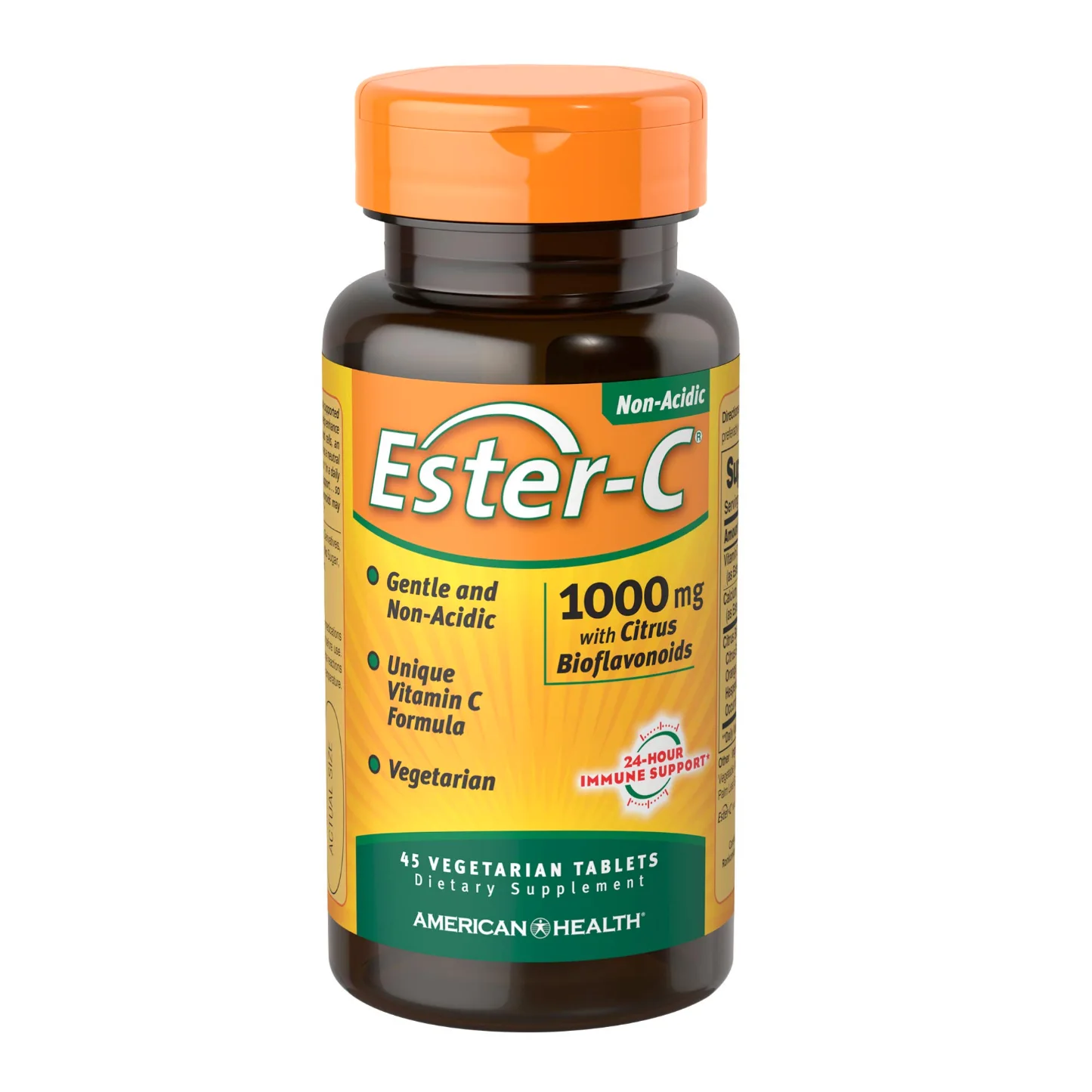
Every product we sell gives 1,000 mg of vitamin C per serving, as Ester-C calcium ascorbate. For an adult man that is about eleven times the RDA. An adult woman gets about thirteen times hers. Against the 2,000 mg upper limit for adults, it is exactly half.
Put plainly, a healthy adult who eats fruit and vegetables most days likely meets the RDA from food already. One of our servings is not filling a measured shortfall for that person. NIH adds that the body tightly controls its vitamin C levels, that higher doses are absorbed less well than moderate ones, and that absorbed vitamin C the body does not use leaves in the urine. A gram a day is a choice some adults make. It is not a requirement, and food comes first.
We would rather you hear that from the people who sell the gram. If you do choose a supplement, the serving is the same across our range and the unit is what differs. The 1000 mg coated tablets are one tablet a day with a meal, at about 13 cents a serving in the 120-count bottle. Our 500 mg tablets and capsules are smaller units, and their box directions call for two a day, which reaches the same 1,000 mg.
Each serving also carries calcium from the calcium ascorbate, 110 mg on most of our panels and 108 mg on the 1000 mg capsules. That calcium counts toward your daily total, which is worth knowing if you already take a calcium supplement. The comparison page sets the products side by side.
What NIH says happens when you take too much
Vitamin C has low toxicity, NIH says, and high intakes are not believed to cause serious adverse effects. At high doses the common complaints are diarrhea, nausea, abdominal cramps and other stomach and gut upset. NIH traces them to the osmotic effect of vitamin C that was not absorbed and stays in the gut.
For adults the Tolerable Upper Intake Level is 2,000 mg a day, and it covers food and supplements together. Long-term intake above that level may raise the risk of adverse health effects. Two of our servings in one day would reach 2,000 mg before a single orange. One serving a day, as the box directs, keeps you well under it. Teens aged 14 to 18 have a lower limit of 1,800 mg, and the limit does not apply to people receiving vitamin C as medical treatment under a physician's care.
NIH names a few cautions beyond the stomach. High intakes can raise oxalate and uric acid in the urine, which could add to kidney stones, especially in people with kidney disorders. Studies on this conflict, and the clearest evidence is in people who already have hyperoxaluria. Vitamin C also increases absorption of nonheme iron. That is not a concern for healthy people, NIH says, but in hereditary hemochromatosis long-term high doses could worsen iron overload and damage tissue.
One more finding appears in the fact sheet. In a study of postmenopausal women with diabetes, supplemental vitamin C of at least 300 mg a day was linked to a higher risk of dying from cardiovascular disease. NIH calls the significance of that result uncertain, since no other study has observed it.
When to talk to your doctor or pharmacist first
Some situations call for a conversation before you start any vitamin C supplement. NIH names two kinds of medical treatment. People having chemotherapy or radiation should consult their oncologist before taking vitamin C or other antioxidants, especially in high doses. Vitamin C taken with other antioxidants may also blunt the rise in HDL cholesterol that the combination of simvastatin and niacin produces, and NIH advises that providers monitor lipid levels in people taking statins along with antioxidant supplements.
Anyone who takes medicines like these on a regular basis, NIH says, should discuss their vitamin C intake with a health care provider. Bring it up as well if any of these apply to you:
- kidney stones, a kidney disorder or hyperoxaluria
- hereditary hemochromatosis
- end-stage kidney disease on dialysis, or a condition that affects absorption
- pregnancy or breastfeeding
- a child you are thinking of giving a supplement to
Then come back to the simplest step. Put your age, sex and situation into our vitamin C calculator and see your RDA and your upper limit side by side. Compare them with what you already eat. If food leaves a gap you want to close, our 1000 mg collection is there, with the numbers on every panel.